 Bancroft,
Mary. Autobiography of a Spy. New York: Morrow, 1983.
Bancroft,
Mary. Autobiography of a Spy. New York: Morrow, 1983.
Bancroft worked for Allen Dulles and the OSS station in Switzerland in World War II, and this work makes explicit that the two were also lovers. "[H]er most important work was with Hans Bernd Gisevius, a top officer of German military intelligence.... [H]er real job was to make sure he was not a double agent (she concluded he was not) and then to elicit and pass on the detailed information he supplied about the day-to-day shifts of power and strategy within the German Government." See Robert McG. Thomas, "Mary Bancroft Dead at 93; U.S. Spy in World War II," New York Times, 19 Jan. 1997.
Breaks,
Katherine. "Ladies of the OSS: The Apron Strings of Intelligence in
World War II." American Intelligence Journal 13, no. 3 (Summer
1992): 91-96.
Although this is a heavily edited (that is, shortened) version of the author's Senior Essay in the History Department, Yale University, it is an excellent introduction to the contribution made by women to the work of OSS. The author concludes: "The role of women in OSS was limited. OSS worked within the gender constraints of the period, hiring most women for gender-specific work and eschewing a leading role in promoting women with skills. But OSS was not regressive either, giving outstanding candidates meaningful work in Research and Analysis and Morale Operations. The work of the women in OSS was a mixed bag, not a treasure trove of opportunity but nevertheless provided one of the few ways women could play a direct role in World War II."
Breuer,
William B. War and American Women: Heroism, Deeds, and Controversy. Westport, CT: Praeger, 1997.
The focus of this work is not on women in intelligence, but rather concerns American women in military service. Nevertheless, Smith,WIR 16.1, notes that Breuer's "stories about women in the OSS and their adventures in France and Switzerland prior to D-Day ... are well told and exciting."
Deschamps-Adams,
Hélène.
1. "An OSS Agent Behind Enemy Lines in France." Prologue, Fall 1992, 256-74. [http://carlisle-www.army.mil/usamhi/RefBibs/intell/ww2/oss.htm]
2. Spyglass: An Autobiography. New York: Holt, 1995.
Surveillant 4.2: This is the story of the author's "years in the French Resistance, and her later work in OSS."
Foster, Jane.
An Unamerican Lady. London: Sidgwick & Jackson, 1980.
Constantinides notes that Foster, who worked in Morale Operations with OSS during World War II, was indicted with her husband in 1957 as Soviet agents. In discussing her OSS experiences, Foster "relates much about personal, social, and administrative matters but precious little about her operations." With regard to the charges brought against her, she denies being a Soviet agent but admits that she lied about her Communist Party membership and marital status.
The indictment against Foster came on the basis of information from FBI double agent Boris Morros. See Morros, My Ten Years as a Counterspy (1959). See also, Conant, A Covert Affair (2011).
Litoff, Judy Barrett, ed. and intro. An American Heroine in the French Resistance: The Diary and Memoir of Virginia D'Albert-Lake. Bronx, NY: Fordham University Press, 2006
From publisher: "Litoff brings together two rare documents" written by Virginia (Roush) d'Albert-Lake -- her "diary of wartime France until her capture in 1944 and her prison memoir written immediately after the war." Viginia and her husband, Philippe d'Albert-Lake, joined the Resistance in 1943. She "put her life in jeopardy as she sheltered downed airmen and later survived a Nazi prison camp. After the war, she stayed in France with Philippe, and was awarded the Légion d'Honneur and the Medal of Honor. She died in 1997."
Lovell,
Mary S. Cast No Shadow: The Life of the American Spy Who Changed the Course of World War II. New York: Pantheon Books, 1992.
Clark comment: This book is about Amy Elizabeth Thorpe Pack, the acquisition of the Italian and French naval ciphers prior to the American landing in North Africa in November 1942, and other espionage sexploits.
Troy, FILS 11.3, says Cast No Shadow is an "excellent work of research and writing." It provides a "convincing account of a sex-obsessed woman who found fulfillment in espionage, as a spy for BSC [British Security Coordination] and/or the Office of Strategic Services (OSS), chiefly in Washington in 1941-42." This is "a good read." Binker, AIJ 13.3, finds that, under the author's "skillful handling," Pack "emerges as a woman of extraordinary courage, daring, intelligence, and character. In short, the perfect spy."
See also, Domenico Vecchioni, Cynthia: la spia che cambiò il corso della seconda guerra mondiale [Cynthia: The Spy Who Changed the Course of the Second World War] (Milan: EURA Pr. Ed. Italiane, 2002).
MacDonald, Elizabeth P. Undercover Girl. New York: Macmillan, 1947.
Constantinides notes that this is "one of the earliest works on OSS Morale Operations (MO) and MO work in China and from India." But that is "secondary to what she revealed of the organization and personalities of OSS in Washington, China, and Southeast Asia.... Her trained journalist's eye caught a number of humorous incidents and the subtleties of OSS personalities." For Pforzheimer, Studies 5.2 (Spring 1961), this work "contains ... the most detailed information publicly available on OSS operations, especially in black psychological warfare, in the Far East."
See also the author's later work: Elizabeth P. McIntosh, Sisterhood of Spies: The Women of the OSS (Annapolis, MD: Naval Institute Press, 1998).
Mansfield,
Stephanie. The Richest Girl in the World: The Extravagant Life and Fast Times of Doris Duke. New York: Putnam's, 1992.
Surveillant 2.5: "A very brief involvement with OSS [in 1945] is described here."
McIntosh, Elizabeth
P. Sisterhood of Spies: The Women of the OSS. Annapolis, MD: Naval Institute Press, 1998. 2009. [pb]
Jonkers, AIJ 18.1&2, notes that McIntosh "joined OSS in 1943 and was part of operations against the Japanese in Burma. After postwar assignments with VOA and the State Department she joined CIA in 1958 and remained there until her retirement in 1973." This is "[a]n entertaining book, with many photos." For Waller, Intelligencer 9.3, the author "serves history well with her book.... Sisterhood of Spies provides an authentic picture of women at war in the demanding field of intelligence." Bates, NIPQ 14.4, recommends this "interesting and worthwhile book." The "author's writing style is delightful."
Chapman, IJI&C 11.4, comments that "The Women of the OSS is a good read. It's fascinating, highly informative, and I learned a lot. My minor criticism is that in parts, where McIntosh deals with spectacular stuff, it's so one-foot-in-front-of-the-other factual that I wished there was more pizzaz to describe the operations of several heroines."
To Westlake, NYTBR, 31 May 1998, McIntosh tells her stories with "brisk polish. Unfortunately, she brings to her task a ... compulsion toward completeness rather than a storyteller's compulsion toward narrative." Smith, Military Review, Jan.-Feb. 2000, regrets that the author "focuses predominantly on civilian women" within OSS, "not the smaller military contingent." Nonetheless, this is a "fascinating book ... [that] combines historical narrative, case studies and oral histories to trace both the development of the OSS and women's expanding roles within the agency."
Hamilton, H-Minerva, H-Net Reviews, Aug. 2002 [http://www.h-net.org], comments that this "book is an interesting look into OSS activities during World War II, including how the OSS started and how it evolved into the CIA." It is, however, "less useful as an in-depth study into women's roles, either in how these activities opened up new roles for women or how women were perceived in these roles. The book touches on these ideas, but only in passing, as they are not central to the book's purpose."
See also the author's earlier work, where she relates her own wartime adventures in OSS Morale Operations in the Far East: Elizabeth P. MacDonald, Undercover Girl (New York: Macmillan, 1947).
Miller, Gene
E. [SFC/USA] "MI Corps Hall of Fame: Virginia Hall." Military
Intelligence 20, no. 3 (Jul.-Sep. 1994): 44-45.
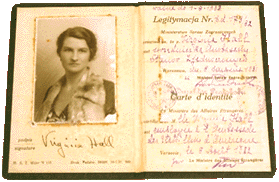 [1]
Adapted from Lawrence J. Cerri, Army Magazine (Feb. 1988). Using the pseudonym of Marcella Montagne, the "Incredible Limping Lady" served in France with SOE and the French underground and, later, in OSS' Operation Heckler preparatory to Operation Overlord. See also, Nouzille, L'espionne: Virginia Hall, une Americaine dans la guerre (2007); and Pearson, The Wolves at the Door (2005).
Montalván , Luis Carlos. "Liberazione d'Ialia: One Woman's War." American Intelligence Jouranl 28, n0o. 2 (2010): 87-93.
The life and especially the World War II years in OSS of Myrtle Vacirca-Quinn.
 Return to Women Table of Contents