Revel, Oliver Buck, with Dwight Williams. A G-Man's Journal: A Legendary Career Inside the FBI -- From the Kennedy Assassination to the Oklahoma City Bombing. New York: Pocket Books, 1998.
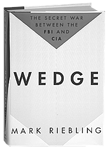
Riebling, Mark. Wedge: The Secret War Between the FBI and the CIA. New York: Knopf, 1994. Wedge: From Pearl Harbor to 9/11: How the Secret War Between the FBI and the CIA Has Endangered National Security. New York: Simon & Schuster/Touchstone, 2002. [pb]
Richard Gid Powers, WPNWE, 7-13 Nov. 1994, calls Wedge a "lively and engaging narrative of interagency bungling, infighting, [etc.] in every known intelligence case." Unfortunately, Riebling has turned his material into "a series of '[f]or the loss of a nail the war was lost' stories." For example, he picks up the old and dismissed tale of Popov's Pearl Harbor questionnaire. "Just as misguided and illogical is his thesis that the Kennedy assassination could have been prevented if the CIA had only passed on to the FBI the news that an official at the Soviet embassy in Mexico City who talked to Oswald shortly before the assassination was a KGB agent attached to Soviet death squads.... This points to Riebling's ... unfamiliarity with authorities like Gordon Prange or Gerald Posner, who have laid to rest so much of this tedious conspiracy-theorizing.... The real story in these superficially exciting revelations of official secrets is that there is no story -- the squabbles between ... Hoover and ... Donovan's many successors do not explain the history of our time."
Surveillant 3.6 says that some of its "reviewers did not find [the author's] research and fact-checking sufficiently rigorous.... 'He does not evaluate ... his sources.... He also repeats errors which have been long since discussed in public print and corrected.... [He has] produced another book on a subject of which he knows very little, and understands less.... For example, he states that the U.S. has the only intelligence and security service in the world which divides counterintelligence into domestic responsibility ... and foreign responsibility.... The author could not be further from the truth.... [E]rrors of fact ... also lead to errors of interpretation.'"
For McGehee, CIABASE, January 1995 Update Report, this book is "so rife with unsupported data and conclusions - it loses all credibility." Periscope 20.2 notes that Sam Papich "disagrees with the author's specific conclusions concerning both the Popov case and the JFK/Oswald case as well as his concluding views." Nonetheless, Papich believes he was treated fairly and the book is worth reading. James E. Nolen comments that after 1972 "the liaison role diminished in importance precisely because a broad exchange at all levels in the field and at Headquarters was developing." W. Raymond Wannell notes that it is "unfortunate the author did not pursue his research to the point of eliminating rumor, speculation and biased sources.... Riebling missed the boat."
Beschloss, NYTBR, 6 Nov. 1994, comments that this "thoroughly researched narrative ... is constructed as a series of tales, peopled by picaresque figures from Ian Fleming to Oliver North." According to Riebling, "the Nixon White House quietly encouraged the two agencies to encroach on each other's territory." The author "succeeds ... in persuading the reader that the F.B.I.-C.I.A. conflict was a more important piece of the cold war mosaic than heretofore noted by historians."
According to Robbins, CIRA Newsletter 20.2, "readers of the innumerable exposes of infighting within the American intelligence community" will find "little in Wedge that is actually new. First-time author Riebling, however, does profit from his experience as a Random House editor to bring an exceptionally readable and coherent account ... into one exhaustively sourced work."
According to Robbins, CIRA Newsletter 20.2, "readers of the innumerable exposes of infighting within the American intelligence community" will find "little in Wedge that is actually new. First-time author Riebling, however, does profit from his experience as a Random House editor to bring an exceptionally readable and coherent account ... into one exhaustively sourced work." NameBase finds Riebling's writing to be "articulate and reflective.... In some sections of this book, Riebling appears to have relied heavily on the assistance he received from Edward Jay Epstein.... Fortunately, Riebling explains the Angleton view so competently that it finally makes sense on its own terms."
Loeb, Washington Post, 21 Oct. 2002, notes that the 2002 paperback edition of this work includes "an epilogue which Riebling uses to update his thesis and outline a string of missteps he believes kept the FBI and CIA from preventing al Qaeda's suicide hijackings." If Riebling's thesis "was provocative at the time, it seems prescient now.... Riebling traces the failure of both the FBI and the CIA to share the ample clues they possessed of an al Qaeda plot to the Ames case and its aftermath. The FBI was given authority to police the CIA and wound up ... eviscerating its clandestine service."
Summers, Anthony. Official and Confidential: The Secret Life of J. Edgar Hoover. New York: Putnam, 1993.
Ambrose, WPNWE, 1-7 March 1993: "Drawing on anonymous and hostile sources,... and relying heavily on innuendo, rumor, hearsay, and his own speculations,... Summers depicts FBI Director J. Edgar Hoover as a moral and political monster without a single redeeming feature.... Much of the material here is familiar, already covered in detail in Richard Gid Powers's 1978 biography.... But the two biographers are often in disagreement. Powers dismisses as 'preposterous' the charge that Hoover was responsible for the intelligence failure at Pearl Harbor; Summers devotes an entire chapter to it. In general, in my opinion, in areas of disagreement Powers's work is better researched and more reliable than Summers's. Except, perhaps, on the biggest disagreement of all...: the sex life of J. Edgar Hoover. Powers found no convincing evidence to prove the widely held belief that Hoover was a homosexual; Summers presents an abundance of evidence to show that he was.... Summers's most sensational charge is that Hoover was a transvestite. His source is Susan Rosenstiel."
Surveillant 3.1 notes that the "fact that Hoover created a smooth law enforcement machine out of a corrupt outfit is left briefly examined in this hostile exposé." The author "has included many half-baked innuendos, gossipy twiddle-twattle, and [every] third-hand smear he could find." Summers claims that "Dusko Popov ... had been sent to warn America that the Japanese were planning to attack the [Pearl Harbor] naval base.... [G]etting someone to give you a quote about a rumour does not make it true."
According to Wannall, Periscope 18.3, Hoover's "vilification rested upon..., principally, a British author [Summers] whose allegations against a previous American public servant (AFIO founder David Atlee Phillips), repeated in a London newspaper, resulted in open-court retraction, apology, and acknowledgement of the payment of a substantial sum in damages." O'Reilly, Policy Studies Journal 21.3, comments that the stories of cross-dressing "may be true, but the 'he said/she said' sources don't prove it." NameBase identifies the author thusly: "Anthony Summers, based in Ireland and best known for his JFK assassination research...." [Enuf' said.]
Swearingen, M. Wesley. FBI Secrets: An Agent's Exposé. Boston: South End Press,1995.
Surveillant 4.2 notes that several retired Bureau officials "have stated ... that portions of the book where they are mentioned contain significant inaccuracies, so readers are warned." Nonetheless, there are significant accusations in this book, including "many tales of institutionalized corruption" at the Bureau. According to Namebase, the author "spent 25 years in the FBI.... Most of his career was spent on political cases.... Swearingen is the first agent to offer an explosive inside look at the FBI's COINTELPRO program."
Theoharis, Athan G. J. Edgar Hoover, Sex, and Crime: An Historical Antidote. Chicago, IL: Ivan R. Dee, 1995.
According to Surveillant 4.2, "Theoharis, a diligent historian and strong critic of the Bureau, examines recent claims about Hoover and calls them simplistic and probably false.... Recommended." Ellis, I&NS 12.2, finds this to be "a satisfying, sober and elegant demolition of sensational revelations about a figure who was tailor-made for conspiracy theorists."
Theoharis, Athan G., ed. A Culture of Secrecy: The Government Versus the People's Right To Know. Lawrence, KS: University Press of Kansas, 1998.
Theoharis, Athan G., ed. From the Secret Files of J. Edgar Hoover. Chicago: Ivan R. Dee, 1991.
Surveillant 2.1 comments that Theoharis, who is one of the FBI's most persistent critics, "seeks to demonstrate the extent of FBI involvement in collecting and using derogatory information about prominent Americans and political groups. Using recently uncovered documents from Hoover's 'Do-Not-File' files, Theoharis charges that Hoover was an 'indirect blackmailer.'" Rosswurm, I&NS 7.4, sees the book as "a very important contribution to our growing knowledge of the FBI and its role in American society" and "a magnificent collection of documents."
Turner, William W. Hoover's FBI: The Men and the Myth. Los Angeles, CA: Sherbourne Press, 1970. New York: Thunder's Mouth Press, 1993. [pb]
Petersen refers to to this book as a "[c]ritical account by a former agent," while Surveillant 3.2/3 notes that it was "[p]ublished to coincide with the release of ... Coppola's feature film on ... Hoover."
Watson, Pat. The FBI's Changing Missions in the 1990s. (Working Group on Intelligence Reform.) Washington, DC: Consortium for the Study of Intelligence, 1992.
Clark comment: The author was Deputy Assistant Director, Intelligence Division, FBI. Surveillant 3.1: "The paper discusses how the FBI has recast its mission in the face of the new international environment and changing U.S. national security policy."
 Return to FBI 1990s Table of Contents